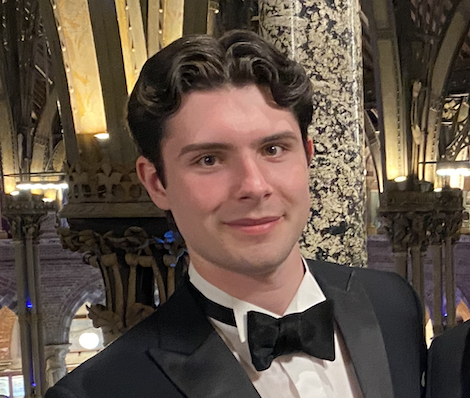
Israel Mason-Williams
PhD Researcher in Safe and Trusted AI
He has published research at world class AI journals and conferences 1x JMLR, 1x TMLR, 1x Main and 2x Workshop at NeurIPS, 1x Workshop at ICLR and 4x Workshop at ICML.
He currently works as a PhD student in theory of deep learning, functional perspectives and science of deep learning, his work draws inspiration from many fields to develop beautiful yet effective solutions to some of the biggest problems in AI.
Life Updates:
Conference paper "Data-Free Metrics Are Not Invariant Under Functionality-Preserving Reparametrisations" accepted at NeurIPS 2026.
Journal paper "A Function-Centric Perspective on Flat and Sharp Minima" accepted at Transactions of Machine Learning Research.
Journal paper "A Functional Perspective on Knowledge Distillation in Neural Networks" accepted at the Journal of Machine Learning Research.
Recieved an Expert Diploma in AI Evaluation from ValgrAI after researching on Microsoft's AgentGuard Project.
Debator on the motion “This House Believes That Prioritising Existential Risks from Artificial Intelligence Distracts from Present Harms” for the Oxford Frontier AI Forum.
Presented a seminar at the University of Cambridge titled “ Using A Function-Centric Lens to Re-consider Regularisation, Representation Transfer and Geometric Properties of Neural Networks” as part of the NLIP Seminar Series series.
Ranked top 1% of reviewers for ICLR 2026: Top 200 Reviewers.
Invited Reviewer for NeurIPS 2026
Selected for the first International AI Evaluation Program fully funded by Coefficient Giving.
Paper accepted at the first Workshop on Technical AI Governance at ICML exploring the role of Reproducibility and AI Governance.
Attended the Oxford AI Gala supported by Athropic.
Completed the Talos AI Governance Fellowship.
Joined cohort 8 of ConceptionX.
Joined the first UK cohort of 50 Years (50Y).
Attended NeurIPS 2024 and presented work on understanding knowledge distillation and geometric properties of neural networks.
Awarded the Simms Prize for Eductaional Achievement from Lucy Cavendish College at The University of Cambridge.
Joined UKRI Safe and Trusted AI CDT as a PhD Student.
Attended ICLR 2024 and presented work on understanding neural network compression.
Joined the University of Cambridge to study an M.Phil. in Advanced Computer Science.
Graduated from Queen Mary University of London with First Class Honours in Computer Science.
Joined the Eurpean Bioinformatics Institute to research protein function prediction with ML/AI.